
Description
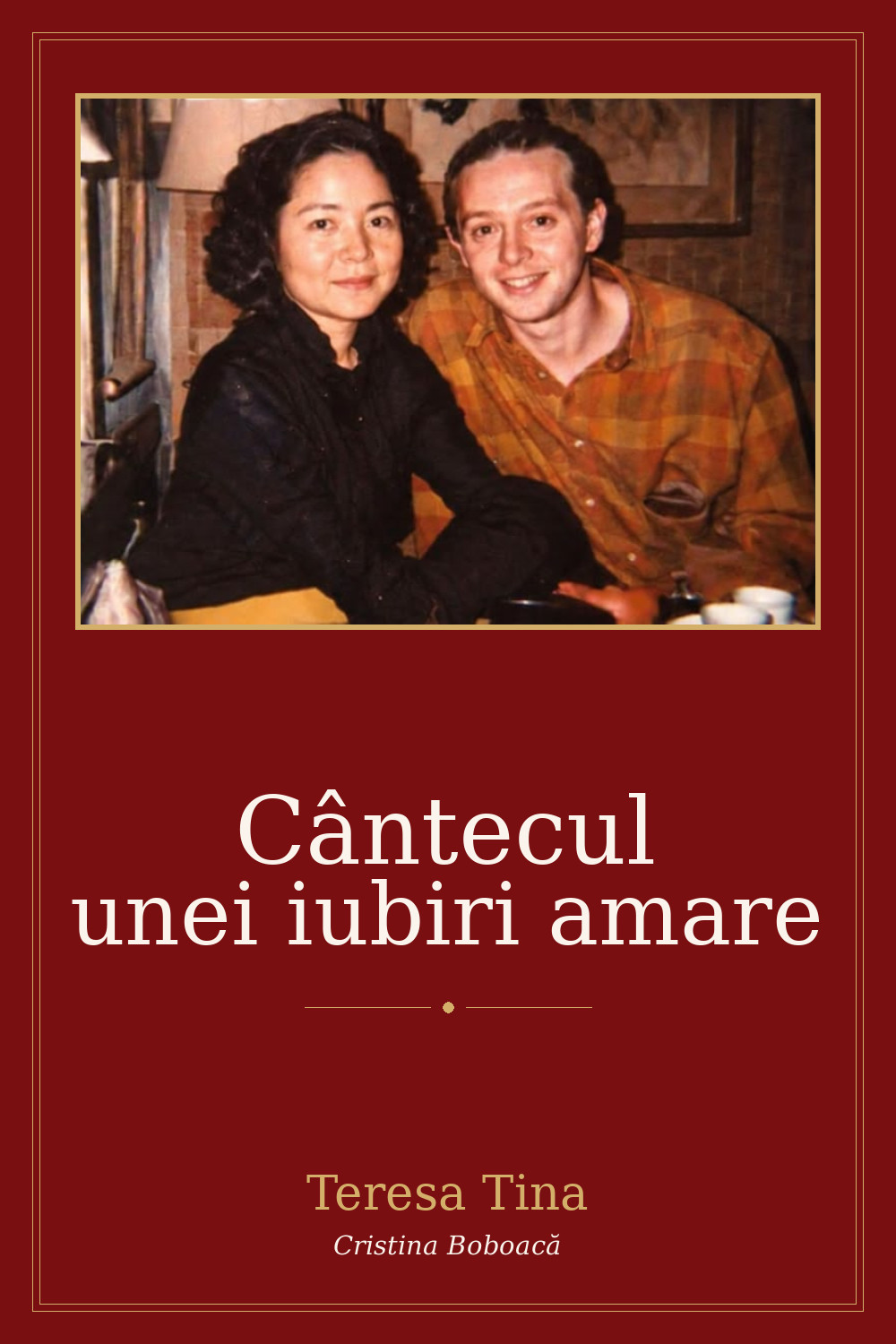
Digital edition (PDF) of the novel A Song of Bitter Love (original title: „Cântecul unei iubiri amare”) by Teresa Tina (Cristina Boboacă). Language: Romanian.
A Song of Bitter Love – the novel in which love becomes destiny, glory becomes loneliness, and death kneels before a love that refuses to disappear
There are books that are read. There are books that are lived. And there are works so haunting that, after the last page, the reader remains captive in a world from which the soul refuses to return. A Song of Bitter Love belongs to this last category. It is a novel of devastating emotional intensity, a symphony of love and suffering, a dizzying journey into the intimate universe of the legendary Teresa Teng — the woman whose voice conquered millions, but whose heart kept searching for what all the glory in the world could not give her: absolute love.
Built on the border between psychological novel, biographical fiction and great romantic tragedy, this work dares to go where conventional biographies stop: into the abyss of a woman’s consciousness torn between fame and loneliness, between desire and sacrifice, between the instinct to love and the desperate need to be loved. Teresa Teng ceases to be only the artist revered by entire generations and becomes a woman of almost unbearable vulnerability, able to conquer the world through song and to collapse inwardly before a single man.
Her meeting with Paul, the young Frenchman who unsettles her existence, opens the gates of a love that seems to spring from a conspiracy of fate. Paris becomes the altar of a sentimental revelation, the city where two seemingly incompatible lives meet to unleash an emotional hurricane. From that moment, the novel takes on the proportions of a modern tragedy. Love becomes a force that heals and wounds, elevates and destroys, promises eternity and threatens to devour everything in its path.
What is extraordinary is the complexity of the relationship between Teresa and Paul. The author refuses to build a simplified love story. Instead of a conventional romance, the reader discovers a universe ruled by passion, jealousy, emotional dependency, pride, tenderness, guilt, separations and reconciliations that take on the intensity of emotional earthquakes. Paul is at once the adored man and the source of consuming suffering. Teresa is the woman who loves with an almost superhuman generosity, but who begins to discover the terrible price of giving up her own identity.
One of the most impressive dimensions of the novel is this confrontation between unconditional love and individual freedom. How much can a woman sacrifice for the man she loves? Where does devotion end and self-destruction begin? Can a great love become a prison? Can a man be saved by the power of a woman’s feelings? And above all, can there be happiness when love demands the sacrifice of one’s own self?
These questions run through the novel like flashes of lightning that, for an instant, illuminate the darkest rooms of the human soul.
Teresa loves with an intensity that defies reason. She gives her time, her energy, her trust, her material resources and, at times, her own peace of mind. Paul swings between overwhelming tenderness and a jealousy that threatens the balance of the relationship. Between the two unfolds a continuous struggle, in which every closeness carries the shadow of a possible separation, and every reconciliation feels like a resurrection.
The novel is striking in the contrast between the monumental scale of an artistic life and the fragility of an intimate one. Before the public, Teresa is a goddess of song. In the solitude of hotel rooms, she becomes a woman who cries, waits, fears, hopes and imagines a house full of children. Within this contradiction lies one of the book’s most powerful revelations: success can conquer the whole world without ever filling the emptiness of a single heart.
Paris, Taiwan, Japan and Chiang Mai form the emotional geography of a life lived at maximum intensity. The cities cease to be mere backdrops and become witnesses to love, to confrontations, to hopes and disillusions. The rain, the hotel rooms, the airports, the concert stages, the restaurants, the mirrors and Paul’s camera all take on symbolic meaning. Every object seems to hold the memory of an emotion. Every journey becomes an attempt to regain a lost paradise.
Music, however, is the true spiritual backbone of the novel. Teresa Teng’s songs are not mere artistic reference points, but extensions of a consciousness that turns pain into beauty. Toki no Nagare becomes the expression of irreversible time, of a love that changes, and of a life sliding inexorably towards its own destiny. The singer’s voice seems to record what her heart senses before reason can understand.
The pages devoted to jealousy, conflict and reconciliation have a particular force. The dialogues reveal two people who love each other deeply, yet hurt each other precisely through their inability to reconcile their emotional needs. Teresa wants love and freedom. Paul wants love and certainty. Between these two longings opens an abyss that passion keeps trying to bridge.
As the story moves forward, the reader discovers that the true tragedy lies not only in the prospect of losing the beloved, but also in the possibility of losing yourself while trying to keep love alive.
In the pages devoted to the last stages of Teresa’s life, the fragility of the body stands in heartbreaking contrast with the vitality of her feelings. Health problems, exhaustion, breathing difficulties and the wish to keep singing add a tragic dimension to the story. The woman who gave her voice to the world begins to feel the limits of her own body, while her heart keeps imagining a future beside the man she loves.
Chiang Mai thus takes on the resonance of a place of destiny, where domestic dreams, tenderness, unease and the foreboding of the end meet in an atmosphere of almost unbearable melancholy.
What sets this book apart is the courage to look at love beyond idealisation. Love appears as a total experience, contradictory, sometimes sublime, sometimes devastating. It can turn an ordinary person into the centre of a universe, and it can make a woman admired by millions vulnerable before a single gaze.
Psychologically, the novel offers a portrait of a woman of remarkable sensitivity. Teresa is generous and proud, clear-sighted and impulsive, strong and vulnerable, independent and thirsty for communion. These contradictions give her literary authenticity. She is not an abstract ideal of femininity, but a living consciousness, crossed by conflicts, desires and existential questions.
The spiritual dimension deepens the drama of the story. God, destiny, faith, sacrifice and hope return as markers of an unending search. Teresa tries to discover a higher meaning in her suffering, to understand whether love is a gift, a trial or a mysterious form of atonement.
The book thus acquires an almost metaphysical dimension. Beyond the story of a famous artist and a young Frenchman, the universal drama of a human being seeking eternity in a passing existence takes shape.
A Song of Bitter Love is, in essence, the novel of a woman who had almost everything and who kept longing for the one thing that neither fame, nor wealth, nor the admiration of the world could guarantee.
It is the story of a love that tries to defeat time, the differences between people, human weakness and the fragility of life.
It is a haunting meditation on the price of absolute love.
It is an elegy for a femininity sacrificed on the altar of passion.
It is a literary testimony to the loneliness hidden behind glory.
And it is, above all, a cry against forgetting.
The novel’s strength lies in its ability to turn an intimate story into a universal emotional experience. Readers find themselves asking not only what happened to Teresa and Paul, but what they themselves would have done in the face of such a love. Would they have stayed? Would they have forgiven? Would they have sacrificed everything? Would they have had the courage to leave? Or would they have gone on loving, in spite of all the wounds?
Like the great romantic tragedies, the novel does not offer the comfort of simple answers. Instead, it compels readers to look into their own souls.
There is a painful beauty in this book, born of the contrast between the splendour of love and the vulnerability of human destiny. The more intensely Teresa dreams of simple happiness, the more unsettling the prospect of loss becomes. The more clearly she imagines a family, a home and a future, the more strongly the reader feels the fragility of all human promises.
And when love meets the irreversibility of death, the story goes beyond the limits of a romantic novel and becomes a meditation on the human condition.
Because the real question this work leaves behind is a shattering one: what remains of a love when time takes away the chance to live it?
The memories remain. The photographs remain. The words spoken in the dark remain. The promises, the regrets, the songs remain, and all those moments people think of as ordinary until they understand they can never be repeated.
The voice remains.
A voice that crosses generations, languages and continents.
A voice that keeps singing about love, even when the woman who gave the world its beauty already belongs to eternity.
A Song of Bitter Love is more than a novel about Teresa Teng. It is a literary monument to imperfect love, to vulnerable femininity and to destinies that burn so intensely that their light continues beyond death.
A book that sets out to unsettle, to stir and to leave in the reader’s soul the echo of an unforgettable question: if you knew that the love of your life would become the greatest suffering of your existence, would you still have the courage to live it?
And the answer this novel seems to whisper, beyond all the tears, all the separations and all the tragedies, is a single one:
Yes. Because some loves are so great that not even death can turn them into the past.
Two artists, two lives, the same wound. When Cristina Boboacă (Teresa Tina) and Teresa Teng meet beyond time, in the same love, the same suffering and the same music
Some encounters between people happen within a lifetime. Some encounters change destinies. But there are also encounters so mysterious, so deeply rooted in human suffering, that they seem to defy time, death and the very logic of existence. The spiritual and artistic encounter between Cristina Boboacă, known as Teresa Tina, and the legendary Teresa Teng belongs to this last category. Two women born in different worlds, under different skies, belonging to distant cultures, find each other in the same universal drama: that of the artist who can give love to an entire world, yet discovers in her own life the cruelty of loving without receiving the happiness she dreams of.
What unites these two women goes beyond a writer’s fascination with a great performer. It is a haunting kinship of the soul, a recognition of one’s own pain in another’s destiny, a confrontation with the same questions that have consumed generations of women: why do we sometimes love precisely the people who hurt us? Why do women able to face the whole world become so vulnerable before the man they love? Why can’t talent, intelligence, beauty and success guarantee happiness? And why, when love collapses, does music remain the only homeland in which the soul can still survive?
Teresa Teng won millions of hearts with a voice of almost unearthly sensitivity. Cristina Boboacă has built her own life around song, literature and a deep need to turn human experience into art. Both belong to that category of women for whom music is more than a profession. It is a confession, a prayer, a way of surviving and, sometimes, the only way to tell the world what they could not tell the man they loved.
This closeness holds one of the most haunting keys to reading A Song of Bitter Love. The author does not look at Teresa Teng’s suffering from the cold distance of an observer. She enters that suffering with the sensitivity of a woman who herself knows the price of heartbreak, of agonising waiting and of loves that leave deep marks on a life.
Teresa Teng and Teresa Tina seem to meet in an invisible place, where glory loses its shine, where the applause falls silent, where the stage gowns are laid aside and only the woman remains. The woman waiting for a phone call. The woman hiding her tears. The woman blaming herself for loving too much. The woman wondering whether the man to whom she opened her whole heart will ever understand the scale of her sacrifice.
What could be more tragic than the destiny of an artist who manages to move millions of strangers, yet cannot receive from the man she loves the same depth of devotion?
This is the tragedy that brings them together.
One sings in Chinese and Japanese; the other stretches her voice and her sensitivity across the borders of languages and cultures. One becomes a legend of Asia; the other tries to bring back into the world’s awareness the story of the woman hidden behind the legend. Between them a dialogue across decades is born, a dialogue in which words become tears, tears become pages, and the pages turn into a song of destiny.
Perhaps the most painful similarity between the two artists is the contradiction between their creative strength and their emotional fragility. In art, the woman is sovereign. She commands her voice, shapes her expression, builds her universe and turns emotion into beauty. In love, the same woman can become the prisoner of a hope, of a promise, of a man unable to understand how much life is being given to him.
Teresa Teng seeks fulfilment in her love for Paul, in a novelistic relationship crossed by passion, jealousy, tenderness and disappointment. Cristina Boboacă recognises her own struggles in this battle between love and dignity, between the wish to stay and the need to save her soul. The two experiences mirror each other without becoming identical. It is precisely their differences that make this closeness so striking: suffering does not need the same biography to speak the same language.
Behind every great artist there is a woman the public knows too little about. Audiences see the spotlight, hear the voice, admire the elegance and applaud the performance. They rarely wonder how many sleepless nights, how many separations, how many humiliations and how many crushed hopes may lie behind a single song.
For Teresa Teng, music becomes the refuge of a heart that keeps loving despite the pain. For Teresa Tina, music and literature become the tools through which personal pain can be turned into creation. Where love life produces ruptures, art tries to build meaning. Where love leaves wounds, song gives them a voice. Where time threatens to bury memories, literature gives them back their existence.
And yet one question hangs over this artistic encounter: who is saving whom?
Is Cristina Boboacă saving Teresa Teng from the oblivion that threatens to reduce an extraordinary life to a few biographical dates and a tragic end? Or is Teresa Teng giving the writer the chance to look at her own wounds from another perspective, to understand that her suffering belongs to a much vaster human drama?
Perhaps the answer lies in the very existence of the novel.
Through A Song of Bitter Love, Cristina Boboacă seems to accomplish a gesture of emotional restoration. In the space of fiction, she gives back to Teresa Teng the right to be more than a symbol of artistic perfection. She gives her the freedom to be vulnerable, jealous, in love, disappointed, generous, contradictory, sometimes powerless before her own feelings.
But at the same time, the writer places her own sensitivity inside this literary construction. Every question about love seems to carry the echo of a personal question. Every separation seems to touch a memory. Every reconciliation seems to awaken the hope that love can overcome what, in reality, people have not always managed to repair.
From here springs the almost overwhelming dimension of this bond: Teresa Tina does not write only about Teresa Teng’s suffering. Through Teng’s destiny, she explores her own experience of love, loss and survival through art.
The two women seem to stand before the same mirror. One belongs to the past, the other to the present. One has ended her earthly life; the other goes on creating, singing and seeking fulfilment. But the mirror shows them the same question: how much of her own life can a woman give to love before she understands that she must keep something for herself?
In this question lies the heart of their symbolic tragedy.
Failure in love does not necessarily mean the absence of love. Sometimes the greatest tragedy is precisely the existence of an enormous love that cannot turn into a happy life. Two people can love each other and hurt each other. They can search for each other and lose each other. They can dream of the same house, the same family, the same future, without managing to build together the peace they long for.
This contradiction runs through Teresa Teng’s story and resonates with the author’s emotional universe. Love becomes at once a blessing and a trial, light and abyss, promise and disappointment.
And the music remains.
It remains when the man leaves.
It remains when the promises fall apart.
It remains when the woman gathers her dignity from the ruins of a relationship.
It remains when the tears dry and the memories keep hurting.
Music is the only lover that never betrays its calling.
For both artists, song becomes a form of resistance against destiny. Every performance can be seen as an attempt to recover what life refused to give. Every musical note carries the possibility of making peace with the past. Every verse turns helplessness into an expression of beauty.
There is something almost unbearably moving in the image of a woman who walks on stage with a broken heart and sings about love to people who believe she is happy.
This image unites Teresa Teng and Teresa Tina in an artistic sisterhood of pain.
These are not two identical destinies, but two sensibilities that recognise each other through the same need for love and the same faith in the power of art. One turned her suffering into songs that have crossed generations. The other tries to turn the echo of that suffering into a literary work able to cross cultural borders and give a legend back her deeply human dimension.
In this sense, A Song of Bitter Love becomes more than the story of a famous singer. It becomes the imaginary place where two artists meet to confess, beyond time, the same wound.
Teresa Teng seems to entrust the writer with the silence behind her songs.
Cristina Boboacă seems to answer her through literature.
One offers the memory of a voice.
The other offers the power of words.
One brings the legend.
The other seeks the woman hidden within the legend.
And together, symbolically, they build a single confession about a love that can raise a person to the heavens and cast her into the deepest chasms of suffering.
But perhaps the most important dimension of this encounter is survival. Teresa Teng lives on through her music. Cristina Boboacă continues her path through song, writing and creation. Beyond the failures in love, beyond the disappointments and the years lost waiting for loves that could never be fulfilled, art remains the proof that suffering can be transformed into something greater than a single life.
Two women. Two voices. Two hearts that have known the fragility of love. Two artists for whom the stage sometimes became the only place where pain could be turned into beauty.
And perhaps this is where the true greatness of Cristina Boboacă’s literary endeavour lies: in the courage to look at Teresa Teng’s destiny through the lens of her own sensitivity, without hiding the contradictions of love, without reducing suffering to a simple romance, without forgetting that behind every legend there is a human being.
It is a meeting between past and present, between East and West, between song and literature, between a woman who became immortal through her voice and a woman who tries to extend her existence through the power of writing.
If Teresa Teng sang of the love that millions of people felt, Teresa Tina tries to write about the love that millions never knew the singer could live with so much suffering.
And so, beyond the differences of era, language and destiny, the two artists come to share the same symbolic loneliness: the loneliness of a woman who gave the world the most beautiful things she had and who kept searching, for herself, for a drop of happiness.
In this light, A Song of Bitter Love can be read as a double confession: the novelistic story of Teresa Teng and the indirect confession of a writer who discovered in the famous singer’s destiny a mirror of her own struggles.
It is a book about love that wounds, about failure that changes lives, about women who have the courage to love again, and about the music that keeps them standing when their inner world collapses.
And if there were a single image able to capture the full meaning of this encounter, it would be the image of two women on two different stages, separated by decades and thousands of kilometres, singing the same pain in different languages.
The audience applauds.
The spotlights shine.
Flowers cover the stage.
But somewhere, beyond the applause, two hearts carry the same unspoken question: why could we make a whole world love us, yet not turn our own love into the happiness we longed for?
And perhaps it is precisely this question that makes the artistic encounter between Teresa Teng and Cristina Boboacă one of the most haunting dimensions of the novel.
Because, in the end, Teresa Tina is not only trying to tell the story of a legend.
She is trying to give her, through literature, what time no longer allowed: one more life, one more voice, one more chance to be understood.
And Teresa Teng, through her songs and her story, seems to offer the writer an equally profound truth:
A woman may lose the love of a man, may lose years of her life, may lose illusions and hopes, but as long as she can still turn suffering into art, she has not lost her soul.
Two artists. The same suffering. The same thirst for love. Two destinies united by music. And between them, a book that tries to turn what life has broken into something time will never be able to destroy.




Reviews
There are no reviews yet.